
The French Renaissance: From Roux and Koffmann to the Modern Bistro Revival


There was a time when French cuisine didn’t just dominate Britain’s dining scene – it defined it. To eat well in London in the late 1970s, 80s and early 90s was, almost by default, to eat French. Starched whites, silver cloches, Gueridon trolleys and a lexicon of sauces that sounded like spells rather than suppers. It was intimidating, thrilling, and for a generation of British chefs, utterly formative.
The Knife examines how French cooking fell out of love and found its way back to Britain.

When France Ruled the Pass
The modern story begins, inevitably, with the Roux brothers. Albert and Michel Roux arrived in Britain in the 1960s and quietly rewired the nation’s relationship with food. Le Gavroche, which they opened in 1967, became London’s first restaurant to be awarded three Michelin stars. More importantly, it became a finishing school. Its kitchen was a crucible of discipline and classicism: sauces mounted properly, stocks respected, technique non‑negotiable. Dishes like quenelles de brochet, lobster à l’américaine and soufflés that actually rose were revelations in a country still shaking off ration‑book habits.
Pierre Koffmann followed with La Tante Claire, bringing Gascon heartiness and a touch of swagger. His pig’s trotters stuffed with morels and sweetbreads became a totemic dish of the era: indulgent, unapologetic, and memorably rich. Raymond Blanc, meanwhile, arrived from Franche‑Comté and planted the flag for French cuisine outside the capital. Le Manoir aux Quat’Saisons wasn’t just a restaurant, it was a manifesto for seasonality, hospitality and finesse, long before those words became marketing clichés.
And then there was Marco Pierre White. Trained under both Koffmann and the Roux brothers, he embodied the intensity of the era. At Harvey’s, and later at Restaurant Marco Pierre White, French technique met British aggression. His white‑hot kitchens, immortalised in photographs and legend, produced dishes like braised oxtail ravioli, caramelised foie gras and impossibly glossy jus; food that thrilled critics and terrified commis chefs in equal measure.
This was the golden age of French cooking in Britain. Menus read like textbooks. The classics ruled: sole meunière, tournedos Rossini, terrines pressed tight and clean, sauces reduced to the point of obsession. Dining out was formal, expensive, and aspirational. French cuisine wasn’t just fashionable, it was the benchmark.

The Slow Fade
But fashions change. By the late 1990s and early 2000s, French cooking began to feel heavy, even old‑fashioned. Britain’s own culinary confidence was growing. Chefs looked north to Scandinavia, east to Asia, south to Italy and Spain. Simplicity, lightness and speed replaced ceremony. The rise of casual dining and global flavours made white tablecloths and three‑hour lunches feel out of step with modern life.
There were other factors too. French cuisine, unfairly or not, became associated with expense and exclusivity. Its language felt arcane. Its rituals intimidating. Meanwhile, a new generation of diners wanted informality, openness and value. French cooking didn’t disappear, but it retreated, often into the background, overshadowed by nose‑to‑tail British cooking, Nordic minimalism, or the thrilling heat of regional Asian cuisines.
The Return of the Bistro
And yet, quietly, French food has been finding its way back, not as haute cuisine, but as bistro cooking. Relaxed, generous, human. The kind of food you actually want to eat on a Tuesday night.
This revival isn’t about reproducing the pomp of the 1980s. It’s about rediscovering what made French food irresistible in the first place: great produce, proper technique, and the simple pleasure of sitting down to eat and drink well. Across London – and increasingly beyond – a new wave of French‑leaning restaurants has emerged, favouring chalkboard menus, good wine, and dishes that prioritise comfort over spectacle.
Think steak frites done properly. Think moules marinière with bread for mopping. Think pâté en croûte, not as a relic, but as a thing of joy.
Two places, in particular, capture this moment perfectly…

Islington, London
There is something quietly confident about Bistro Sablé. The latest addition to the Noble Inns family – which includes the award‑winning The Pig & Butcher just down the road – it feels less like a new opening and more like a place that’s always been there.
Housed at 63–69 Canonbury Road, in the space formerly known as The Smokehouse, Bistro Sablé opened its doors on 3rd November and immediately set about doing what the best French bistros do: creating a room people want to be in, and food they want to return to.
The 65‑seater restaurant unfolds across two spaces. On arrival, guests are drawn into the bar area first: a handful of tables, stools at the counter, and an easy sense of conviviality. It’s a place for an apéritif, a glass of wine, or a casual bite that might easily turn into something longer.
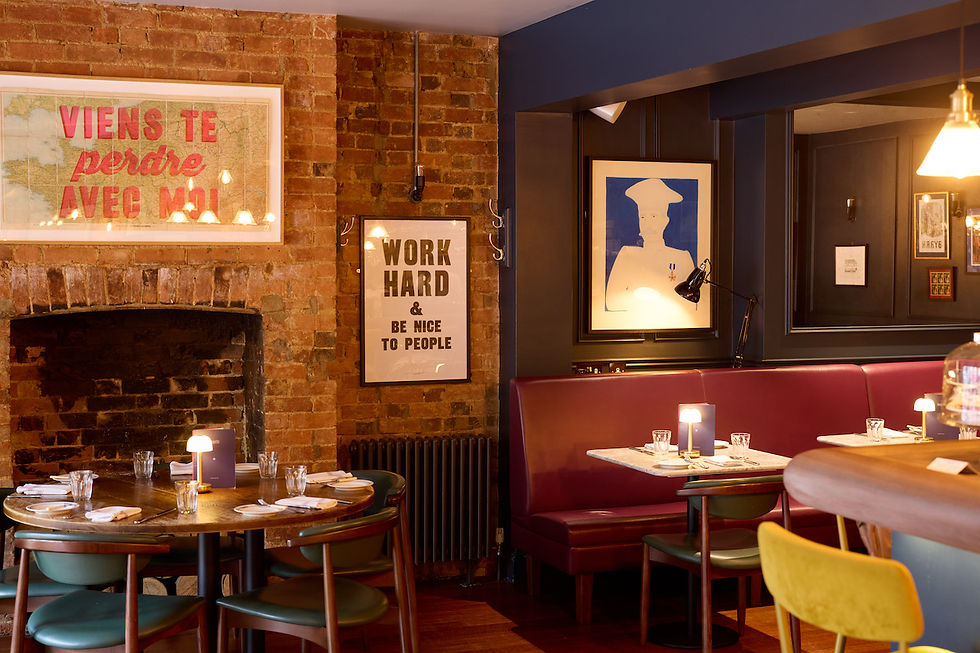
Beyond, the dining room stretches laterally, demarcated by simple white tablecloths, classic bistro chairs and pockets of banquette seating. An open kitchen lines the back wall, lending warmth and intimacy, and reinforcing the sense that this is a restaurant comfortable with being seen.
The look is unashamedly French. Multiple trips to Parisian flea markets have filled the space with wit and character: sketches, cartoons and pictures scattered across whitewashed walls; polished copper pans catching the light; an original 'Boucherie' sign hanging proudly. It’s bistro chic without the pastiche.
The menu is a tight, affordable canter through the classics, changing with the seasons. Autumn, for example, brings earthy pleasures: Moules Marinière to start, or a well‑made pâté en croûte. Mains might include a confit duck leg with crisp skin and yielding flesh, or pan‑fried cod cooked simply and well. Desserts are non‑negotiable: vanilla crème brûlée with that essential crack, or a Valrhona chocolate mousse studded with cherries.
The wine list, curated by former Mere head sommelier Alex Corvez, is all French and all common sense. Ninety‑five per cent of it is available in flexible measures: 75ml, 125ml, carafe or bottle, encouraging exploration without commitment. A coupe of Champagne or a French 75 sets the tone nicely, while beer drinkers are equally well looked after.
Even Sunday lunch has been gently Gallicised. Under the banner 'Les Rosbifs', Bistro Sablé serves the Noble Inns' trademark roasts, properly garnished and served from midday until 9pm – proof that French cooking needn’t be precious to feel authentic.
With a large front garden offering shade in summer and heaters in cooler months, Bistro Sablé feels like the neighbourhood bistro Londoners have been quietly craving: relaxed, reliable, and rooted in pleasure. Forget the airs and graces. This is French food doing what it does best – making life taste better.

Summertown, Oxford
If Bistro Sablé represents the capital’s renewed love affair with French cooking, Pompette shows how far the revival has travelled beyond London.
Opened in Oxford’s Summertown in 2018, Pompette has become a cornerstone of the city’s dining scene and a key player in the national resurgence of casual French bistros. Named after the French word for 'tipsy', it perfectly captures the mood owners Pascal and Laura Wiedemann set out to create: playful, welcoming, and gently indulgent.
Pascal’s pedigree is serious – his career in London includes formative years working with Henry Harris at Racine, opening Terroirs with Ed Wilson, and later Six Portland Road – but the cooking at Pompette wears its skill lightly. Rooted in classical French technique, the menu is shaped by rustic home cooking and a broader European outlook. The result is food that feels both special and deeply familiar.
Menus change daily, but certain touchstones remain. Soupe de poisson arrives rich and restorative, served with rouille and croutons. Duck confit and crème brûlée anchor the bistro canon, while charcuterie – terrines, rillettes, pâté en croûte – speaks to a nose‑to‑tail ethos that values flavour over flash.
There is generosity here, too. Set menus might pair moules à la crème with frites and a glass of Picpoul de Pinet, or poulet with tarragon jus, mayonnaise and a carafe of house wine. The daily 'Pompette Baguette', made using a 48‑hour process and served with French salted butter, is reason enough to visit on its own.
The room itself is a modern bistro done right: colourful and relaxed, with a partially open kitchen and a charcuterie counter on full display. Upstairs, a private dining room seats 16, reinforcing Pompette’s role not just as a restaurant, but as a place for gathering.
That French renaissance now extends beyond eating out, too; Pompette is launching its debut cookbook – a heartfelt collection of comforting, classical recipes – alongside an exclusive range of organic wines produced in the south‑west of France. It’s a natural evolution for a restaurant built on warmth, integrity and the simple joy of eating well.

Back Where It Belongs
French cuisine’s return to favour isn’t about nostalgia. It’s about balance. After decades of chasing the new, diners are rediscovering the pleasure of the known‑good: sauces that comfort, dishes that satisfy, rooms that invite you to stay for another glass.
In places like Bistro Sablé and Pompette, French cooking has shed its stiffness and remembered its soul. Less theatre, more pleasure. Less intimidation, more appetite.
After all these years, French cuisine hasn’t so much staged a comeback as reminded us why we fell in love with it in the first place.
Bon appétit.


