
Cooking with Heritage, Heart and a Pink Knife: A conversation with Chef-Patron Ayesha Kalaji, Queen of Cups

Fresh from being named Chef of the Year at the Estrella Damm Top 50 Gastropubs 2026, Ayesha Kalaji is still processing the moment. At Queen of Cups, her Michelin Bib Gourmand restaurant in Glastonbury, Jordanian heritage meets Somerset produce in a style that is deeply personal, emotionally driven and unmistakably her own. In this candid conversation, Kalaji reflects on identity, community, representation and the instincts that have shaped one of the UK’s most distinctive kitchens.
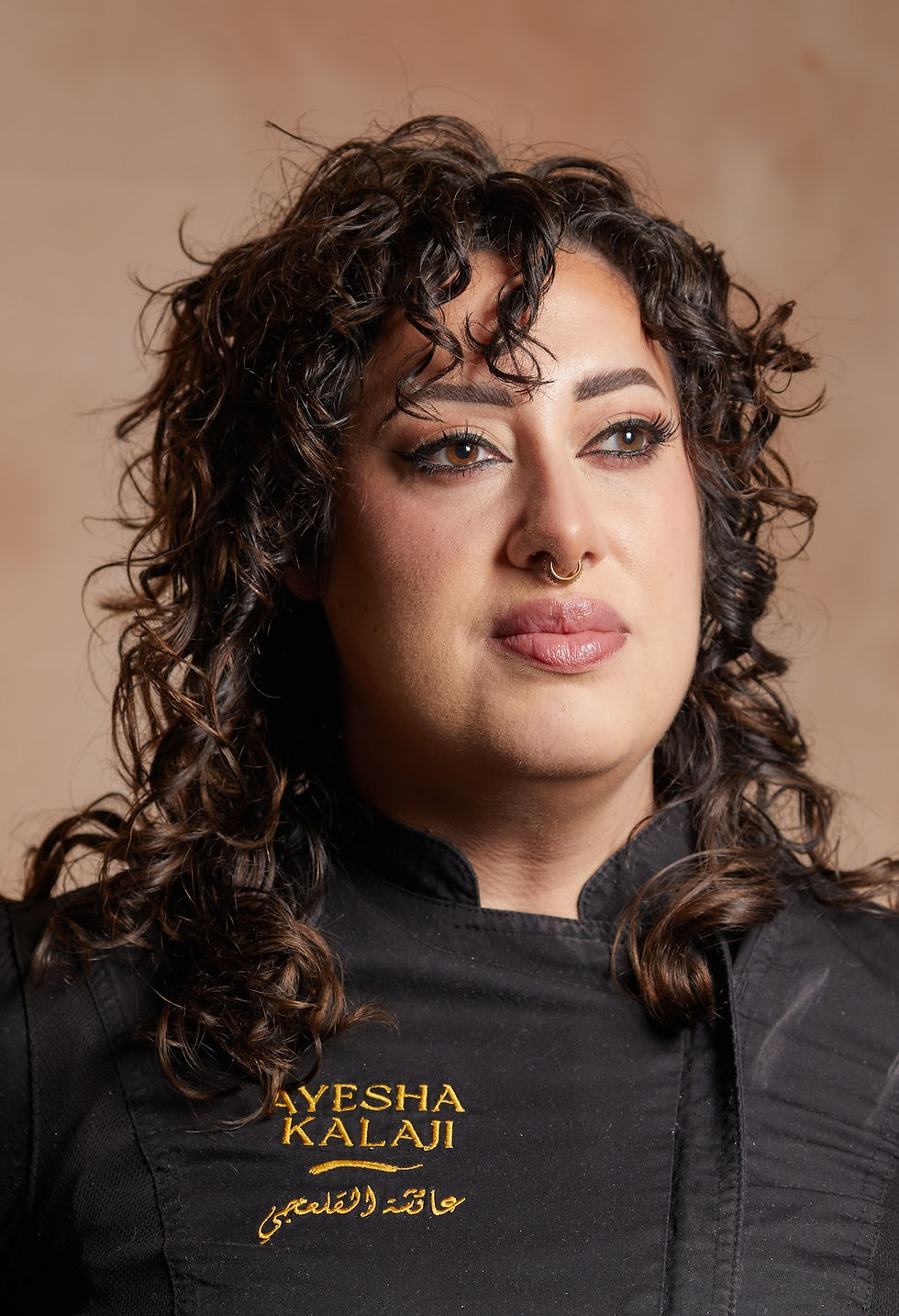
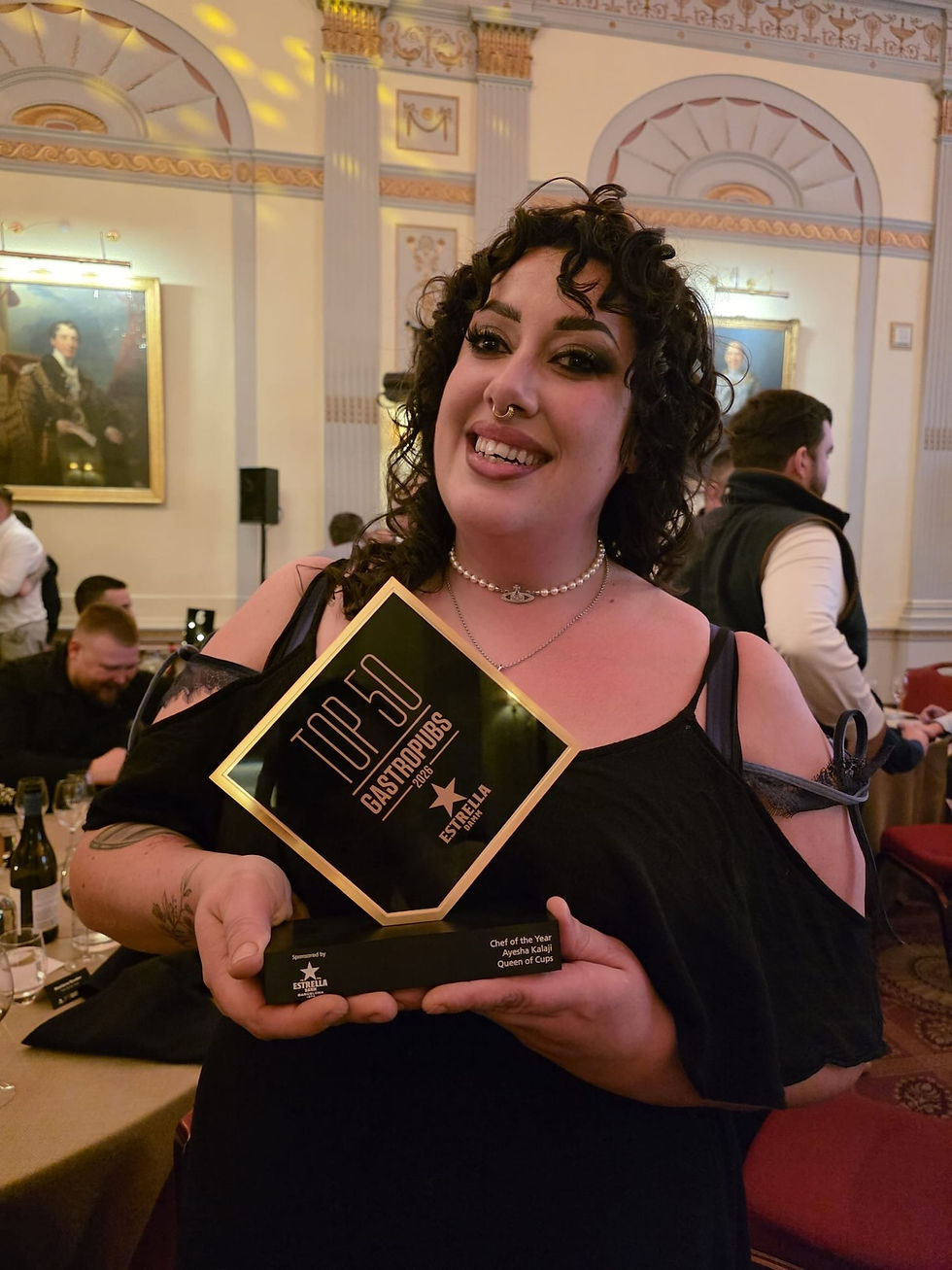
Congratulations on recently being named Chef of the Year at the Top 50 Gastropubs, and with Queen of Cups also debuting at number 42. Once the initial shock wore off, what did that recognition really mean to you personally and professionally?
I must admit that I’m still pretty shocked! My food is deeply personal in that it reflects my heritage, my culture, my experience and truly embodies who I am as a chef and as a person. I’m very singular in what I do, and have dedicated countless hours to my craft, so to have some sense of recognition for that is astonishing and ultimately hugely rewarding. I’m doing something entirely different to everyone else on the list, and often half-joke that I just make fancy hummus. Clearly people see what I do as more than that and that is so hugely validating. Running a business alone is exhausting and there are many parts that are thankless and hard, so this award makes me feel seen. It means that all the hours, hard work and sacrifices have been worth it. I am doing something right, and that feels incredible.
Queen of Cups sits between the worlds of gastropub and destination restaurant. How intentional has that balance been, and do you feel the award validates that hybrid approach?
Queen of Cups positions itself in a few different areas in that we are a gastropub, but we are also a freehouse, a Michelin Bib Gourmand restaurant, a live music venue, a celebration of Jordanian culture and Somerset produce, showcasing classic techniques but incorporating molecular gastronomy. We straddle a few worlds but have never sought to do so intentionally. The hybridisation of our style has been entirely natural in its formation. I had my vision for what Queen of Cups would be and have unwaveringly followed this crystalised vision. It just so happened to fall in multiple categories naturally. I’m unsure as to whether this award validates this approach, as I see it more so as a celebration of what we are doing, which just so happen to be doing it our way. It’s rewarding to know that being different and being true to one’s vision works. We’re a bit quirky, a bit off the wall sometimes, nonetheless very serious about what we do, and I’m phenomenally proud that we have been awarded while continuing to be our unique self.
Your cooking draws deeply from your Jordanian roots, but it never feels nostalgic for nostalgia’s sake. How do you decide which traditions to honour faithfully and which to reinterpret?
My food is a snapshot of who I am as a person and my cultural experiences. I didn’t grow up with an Arab community around me and my exposure to my own heritage was limited to holidays to Jordan and the time spent there with my family in summers. I had to seek out my own identity and learn about it through reading, talking, eating and watching. As such I am not traditional, my experience is not traditional, but it is still intertwined with memories of my grandmother’s kitchen table. This is evident in my food and the way in which I honour my heritage. For example, hummus is part of the MENA lexicon and there are some dishes you just don’t mess with. We can trace the origins of hummus archeologically back to 2500 B.C.E and its first written record to the 13th century. As such it is a dish that is steeped in history and cultural significance. It has been made for millennia, and it doesn’t need to be changed. Although that doesn’t mean I can’t play with it, have fun with it, create unique and surprising toppings, and make it my own. Yet I still have this sense of national and cultural pride that drives me to always pay respect to the original dishes.
I would say that I pay homage and I don’t subvert them beyond recognition, but I never purposefully aim to make anything that is classic. That wouldn’t be true to me. I make a falafel, but it is my falafel, mixed with Welsh laverbread to represent my childhood in Wales. Every decision I make with my menus and my dishes are genuine to me.
The only entirely traditional dish is the first on my set menu and at the top of my a la carte menu. It is my Teta’s (grandmother’s) pickled turnips. I can vividly picture great jars of bright pink pickles, set against the yellow and blue tiles of her kitchen; garishly pink and always present through my childhood and adulthood. Guests at Queen of Cups will start their meal with my grandmother and end it with me. It shows the guest where I’m from, who made me and what I came to be.
It may not be authentic in the traditional sense, but my food is authentic to me.
Glastonbury has its own mysticism and energy, and the Queen of Cups tarot reference runs through the restaurant’s ethos. How much does place influence your food?
The Queen of Cups card embodies a female energy that exudes a caring, nurturing and compassionate energy, which is evident in the food I serve and the way I work. Being in Glastonbury, most of my guests recognise the name as a card in the major arcana. I’m guessing a lot of the readers of this will have to go away and Google the major arcana. This is the norm for Glastonbury though. It’s esoteric, it’s vibrant, it’s unapologetically unique. Most people I know can tell you their planetary birth charts or can recommend a great palm reader. My locals are colourful and interesting, and I adore feeding them and being part of the community. One of the most wonderful things about Glastonbury is how accepting everyone is. I was able to move to the area and make my food and be welcomed by the local community. I’ve never had to compromise on my food, and for that I am so grateful. That does not mean I have not been influenced by the place though. I’ve watched my food grow and evolve which influenced by the produce, the farmers, the local growers and crafters. I moved here and truly rooted myself in seasonal local produce, with the aim to get as much as I could locally and to celebrate and champion local suppliers. Ingredients that may not traditionally be found on the Jordanian dinner table find themselves on mine. The basbousa soaked in Somerset Cider Brandy, the shishbarak with Middle White pork, parsnips from the farm three miles away and the Fowey mussels cooked in Jordanian arak and served with White Lake Fetish (a local feta style cheese, but they cannot call it feta because it is not from Greece!). The land has absolutely shaped the food I cook and helped me grow as a chef.
Winning Chef of the Year as only the second woman since the award launched is significant. Do moments like this change how visible responsibility feels or is that pressure something you’ve always carried?
Even now in 2026 I’m still aware of being in the minority at award shows. People still ask me which chef I’m at the event with, or am I part of the PR teams. There is this assumption that because I’m wearing a dress, I cannot be a serious chef. The rooms are filled with mostly men, and although progress has been made and there are increasingly more incredible women in the room, this is a male dominated industry and that is something that I cannot ignore. Not only that, but I am an Arab woman, so I feel a dual responsibility to represent not only my gender, but my ethnicity too. For much of my career I didn’t see people who looked like me and it felt like there was no place for me at the table, but I am incredibly stubborn and ambitious, and I have fought hard to carve out a seat for myself at the table. I’m fiercely unapologetic about who I am and what I do, and I will not let anyone’s preconceived notions of what I’m capable of because of my gender define what I can achieve. And I’ll do it wearing perfect winged eyeliner while wielding a pink knife.
The fact that we are still having the conversation about how it is such an achievement to be the second woman to win this award highlights how far we have yet to go. Nonetheless I am so grateful for the opportunity to be paving the way for other women, and I do not take this privilege for granted. I will always champion the incredible women in the industry, and I look forward to seeing the women who win this award after me.
Queen of Cups has picked up a rare run of awards in a relatively short time. Has that external recognition changed how you cook, or has it reinforced trusting your instincts even more?
I must admit I’m always shocked every time we win an award. There are an absolute multitude of photos of me collecting awards looking utterly flabbergasted. I still call my mum every time I win an award crying and tell her how surprised I am, and in true mum fashion, she always tells me how silly I’m being and how much I deserve it. I trust my instincts intrinsically and I never waiver from my identity as chef. Yet despite being so singular and decisive in what I do, I am aware that what I do is different, and that I’m different too, and I cannot help but have a sense of imposter syndrome. I’m a jumble of contradictions and juxtapositions in that I am so fiercely proud of what I produce, but I also never think that I’m good enough. This self-doubt continues to drive me to be better though. The food I produce now is infinitely more creative and refined than the dishes I was creating when we first opened. I credit this to my desire to always be better, do better, and prove to myself that I do actually deserve these accolades. Other people clearly think I deserve these awards, but it’s about time I started to believe it too.

Middle Eastern food in the UK is finally being discussed with more nuance and respect. Where do you think the conversation still falls short, particularly outside London?
I am repeatedly referred to as Lebanese, which is not a problem, but I’m not Lebanese. Customers, interviewers and press alike have referred to my Lebanese food. Again, there is nothing wrong with being Lebanese, but I am not Lebanese, I am Jordanian. Although our countries are neighbours and we have many similarities and shared dishes, we are also immensely proud people who have our own national dishes and diverse and individual food cultures. Having said this, I cherish the opportunity to teach people something about the food of my people in national sense, but also in a larger regional sense.
London is still lightyears ahead of other parts of the country as it does have the largest Arab community in the UK. I can find Syrian and Lebanese shawarma on Edgeware Road, and there are chefs like Fadi Kattan celebrating his Palestinian heritage in the Bib Gourmand-winning Akub. There is representation and conversation throughout the city. I was fortunate to cook alongside five other Arab women at Fortnum and Masons for Iftar two years ago. We were Tunisian, Iraqi, Bahraini, Omani, Jordanian and Egyptian. Even though we share a language (although I cannot understand North African Arabic to save my life), we all had our own food histories and traditions. Our dishes were all so different, with our own spice blends, ingredients and methods. From the street vendors to the fine dining establishments, our food is being treated with nuance and individuality.
Outside of London, especially in rural areas, the conversation still has a long way to go. But that is simply due to smaller communities and less globalisation in the food scenes. I do not blame people for not knowing that I’m Jordanian or not knowing the difference in our dishes. I can count the number of Jordanians in Glastonbury on one hand, and our food is still not famous like other Arab cuisines. But I will tell anyone who will listen about makmoura and mansaf, and how the best jameed is from Karak.
That being said, my food often reflects a sense of pan-Arabism in that not only do I create uniquely Jordanian dishes, but I also celebrate food from across the MENA region, utilising spices from Palestine, condiments from Yemen, bread from Morocco. I make a concerted effort to ensure my staff are well trained and explain every element and where they are from when they take dishes to the table. In our own way we are teaching people. It starts like this, in small restaurants in Glastonbury, where our customers now know all about the cheese that they make in Nablus.
Your menus feel deeply emotional as well as technical. How do you want guests to feel when they leave Queen of Cups?
First and foremost, well fed. I have told people to wear trousers with an elastic waistband when they eat with me. It is a trait I have inherited from my Teta; I am a consummate feeder. My love language is feeding people, and I want to show my appreciation to every person who steps over my threshold, as I am so grateful that they choose to spend their money on my food! Not only that, but I want them to be excited and wowed, and to have learnt something or tasted something new. I want them to leave and know who I am and what I’m all about. Every dish is personal, and I truly pour my heart into every part of it. From the food to the wine list, to the cocktails, to the chairs they sit on; everything has my fingerprint on it, and I care so deeply about the guest’s entire experience. I want them to know that. I want them to feel cared for, and appreciated and nourished. Not just nourished in the sense of a meal but nourished as a whole.
You’ve appeared on MasterChef: The Professionals, Great British Menu, and more recently, podcasts. What do those platforms give you that the kitchen doesn’t, and vice versa?
Very few restaurants can exist inside a media vacuum and survive. Although there are some exceptions that can survive on reputation alone, we do live in a digital age where media and social presence is essential to bring customers in and garner any form of reputation. Being in rural Somerset, it conspired that going on these shows and putting myself in the public eye has been incredibly important. After my first episode on MasterChef aired our website crashed three times that day due to the number of people trying to book with us! Although we had an excellent reputation locally, we have had customers drive from all over the country to eat with us. It is amazing and I’m incredibly grateful for the subsequent effect these shows have had on my business. Especially in this economy! Bear in mind I didn’t win either of the competitions I have competed in, yet every time I find myself fortunate enough to go on TV or podcasts the bookings go up. I have yet to watch my own episodes of MasterChef and GBM, but I’ve been told I was very endearing, entertaining, slightly bonkers and cried a lot. I clearly did something right!
Not only have these shows brought customers to my door, but they have given me an opportunity to talk about the ingredients and food I love. I made Marcus Waring sniff my freekeh and talked at Spencer Metzger at length about shatta and molokhiya. This is the food I love, and I relish any opportunity to talk about it. Subsequently the larger the platform, the more people I can expound the joys of sumac to!
But my first love will always be my kitchen. Producing the food I love, spending time with my team, talking to customers over the pass, working with incredible ingredients, recipe testing – this is my purest form of joy.

As Chef Patron, your role extends far beyond the stove. How has your leadership style evolved since opening in 2021, especially as the restaurant has grown in profile?
First and foremost, I am human and I am continuing to grow and improve. I’ve made mistakes along the way, but I always try to be the boss that I would have always wanted to work for. I have always led with a humanistic approach, and I care deeply about my team. Perhaps to a fault some could argue!
One of the hardest skills I’ve had to learn over the last five years has been delegating. I cannot do everything, as much as I want to. As our profile has grown, I have been taken away from the restaurant for work events, and I have had to learn to trust the people around me with my baby. The first few times were ever so hard, but now I know that it is in capable hands. My team are incredibly supportive, and I am so profoundly thankful for their hard work.
I think I’m still as kind as I have always been. I’m shrewder, more financially savvy, firmer, wiser, but I’m proud that I’m still kind.
Queen of Cups is rooted in community as much as craft. How important is local support to what you’re building and how do you keep regulars feeling just as valued as first-timers?
The awards, the accolades, the TV and press, they wouldn’t exist were it not for my locals and regulars who show up on those quiet January nights. When I wasn’t sure it would work out, when I didn’t know if it was all worth it, my regulars are there. They come and try every menu change, every new dish, they give me feedback and genuinely care. I know so many by name, and some I now consider good friends. The ones who bring me in baskets of tomatoes or quinces in exchange for a pint of cider, the ones who order a round of drinks for the team, the ones who I bump into on the street and run late because we’ve got caught up chatting, these are the people who are at the heart of Queen of Cups and the people I set this restaurant up for. We’ve always been incredibly mindful of the cost of our food, and our local economy. I have always maintained the philosophy that I want the people who supply my food to be able to afford it too.
Five years in and when I know one of my regulars is in, they will be greeted with a big grin and an extra plate of falafel.
What excites you most about what comes next for Queen of Cups and yourself?
Where do I begin? I’m excited for all the events and collabs I have lined up. I’m excited for new dishes, the changes of ingredients over the seasons. I’m excited about all the new people I am going to cook for, all the people returning. Winning the Estrella Damm Chef of the Year is going to open so many doors, and I’m so excited to go through them and see where they lead!


