
A Comeback with Bite: A Conversation with Chef Scott Hallsworth, Joe’s Oriental Diner

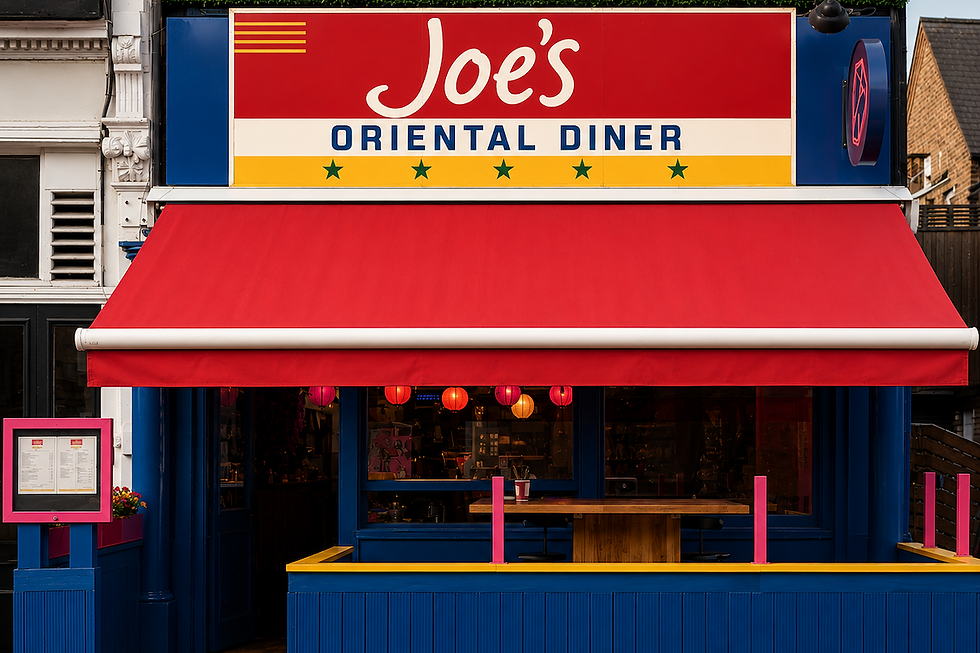
Scott Hallsworth has brought Joe’s Oriental Diner back to London, opening in Balham in the former home of Freak Scene. The original Joe’s was a tiny, lively spot on King’s Road; this new chapter keeps its bold flavours and easygoing spirit while giving it a neighbourhood to call home.
The former Nobu chef tells The Knife why he chose to put Freak Scene on ice, how a trip to Singapore inspired his Chilli Crab Wonton Bombs, and what he hopes will make Joe’s the kind of place Balham locals visit again and again.

What made you feel that now was the right time to bring Joe’s back?
We came to a point with Freak Scene where, in order for it to survive, it was having to become too heavily diluted. We basically had a choice: change what Freak Scene really is, or put it on ice and look to move it to a different location, wherever that may be, so that it can remain true to what Freak Scene was supposed to be. We were buying ingredients that just didn’t suit Freak Scene and watering things down because economically it was just too tough.
Joe’s was always intended to be that cheaper, more affordable spend. It uses different ingredients and it’s perhaps a more casual style of service. So given the economic restraints we’re facing, rather than continuing to water down something I really believed in, it felt like the right time to shelve Freak Scene and bring Joe’s back. I think Joe’s sits really well within a certain price point and style of service for right now.
When you think of the original little restaurant on King’s Road, what do you miss most about it?
There was some magic about that room. It was the launch pad for Kurobuta, and almost completely by accident we ended up there, but it turned out to be the perfect little launch pad. I miss the intimacy of the room. And it was the guests as well, it wasn’t just what we brought to the table. I think there was a perfect combination of things going on. It was very rock and roll. It was rough around the edges, and we were trying to do the best food we possibly could out of this tiny little kitchen. We barely had anything to work with. We were short on everything, but there was just something about that room. You could almost talk to everybody in the restaurant from the pass, and we did. It was a really, really special vibe and a spectacular time.
Joe’s is opening in the former home of Freak Scene. Does walking into that space feel like a fresh start, a homecoming, or a bit of both?
Definitely a bit of both. The bones of Freak Scene are still there and there are obviously some of its hallmarks in the room, but Joe’s has its own identity and it’s already starting to feel like its own place. So there’s a familiarity to walking into the room, but at the same time it absolutely feels like a fresh start. Joe’s has brought a different energy to it.

What did you want to keep from the original Joe’s, and what did you want to do differently this time?
I remember the first photoshoot we did at the King’s Road location with Glenn Burrows, who’s a friend and a great photographer. I remember telling him that I was taking inspiration from the Tom Waits song Singapore. In my head, Joe’s was this strange old portside bar where people from all over would somehow end up. It was weird and curious, and there was this fascination with the Orient that you get from that Tom Waits song. I wanted Joe’s to somehow capture that feeling – a kind of curious Oriental dive bar.
With the food, I think I’m still chasing some version of that. It’s my own curiosity about those dark alleys of Southeast Asian cities where all the real treats seem to be hiding. I want to retain some element of that in the food, whatever that might be. I still don’t completely know how to define it. It’s more of a feeling than anything else.
As for the actual room, I probably don’t want it to literally be a dive bar anymore! I love the idea of one, but I’m not sure it’s somewhere I’d particularly want to spend every night these days. But I definitely want to retain something from that weird conversation I had with Glenn all those years ago.
You’ve cooked at Nobu and built restaurants with a much looser feel. What’s the most useful thing fine dining taught you about making food people want to eat more frequently?
The thing about Nobu is that, whether you want to call it fine dining or not, there was always a focus on flavour. It wasn’t about trying to make something look fancy. The food looked great, but it was generally very simple.
I remember talking to Jamie Oliver one night after he’d finished dinner and he made a comment along the lines of, "This is about as fancy as I’d want to see food. I’m all about flavour." That really struck a chord with me. Then fast-forward through Kurobuta to Freak Scene in Soho, and Tim Hayward wrote something in the Financial Times along the lines of me making the kind of food that people who really love eating food love to eat. That sort of solidified it again for me.
Sometimes there can be a lot of style over substance. I don’t want to spend hours and hours making something look incredibly beautiful just for the sake of it. Food is there to be eaten. Of course it should look nice, and I completely appreciate that incredibly artistic Michelin style of cooking – there’s absolutely a place for it – but it isn’t really what drives me. Some of the most disappointing flavour experiences I’ve had have actually been in beautiful one and two-star restaurants: immaculate rooms, immaculate service, beautiful plates, but the food doesn’t necessarily knock you over. Then you can be down some dark alley in an Asian city and eat something that absolutely blows your head off. That’s food, right? So that’s probably the biggest thing I took from Nobu and everything since: ultimately, it has to be really delicious.
Your menu draws on food from Thailand, Malaysia, Singapore and beyond. What makes a dish feel like it belongs at Joe’s?
I don’t deliberately set out to explore those cuisines as such. I tend to put together dishes that I’ve come across or been taught over the years – through working with chefs from those places, travelling in those countries, or just eating something that really struck a chord with me. They’re normally things that are punchy and make you think, "You’ve got to have this dish." When I’m putting a menu together, I often think: if I walked into my own restaurant tonight, what are the six or seven dishes I absolutely have to eat? Then I balance the menu from there: different textures, flavours, richness, freshness, all of that.
The fact that those dishes happen to come from Thailand, Malaysia, Singapore or wherever is almost the second part of the thought process. They’re interpretations, obviously, but generally they’re derived from real experiences – places I’ve been, things I’ve eaten, or chefs and cooks I’ve been lucky enough to work with.
Singapore Chilli Crab Wonton Bombs sound like they’ll demand a second order. How did that dish come about?
Singapore was a massive inspiration to me. When I was 19, I was an apprentice at a hotel in Bunbury in Western Australia. The hotel was owned by a Singaporean company, and every year they’d send chefs over from their hotel in Singapore to do a Singapore food promotion on our buffet. As a hungry young apprentice, when that hot buffet got wheeled back into the kitchen after lunch or dinner and we were allowed to eat the leftovers, I was blown away. I’d grown up eating plenty of Anglo-Chinese food, but suddenly these flavours were hitting me and they were insane.
Eventually they had to choose a couple of chefs to go to Singapore and do an Australian produce promotion at their hotel, and I got picked. So I’m 19 years old, in and around Chinatown almost every night for a few weeks, with chefs taking us out to eat. I remember eating Singapore chilli crab in this intense heat and humidity, with a big beer getting warm far too quickly, chilli sauce dripping all over my hands and face and across the table. And that was completely fine – you just got stuck into this incredible crab. That experience lodged itself in my mind forever.
Then fast-forward to when I was working at Hayman Island Resort in the Whitsundays. I worked side by side for a long period with a Singaporean chef who had written a book on Singaporean cuisine, and he taught me the secrets of that dish.
Years later I wanted to put chilli crab on the menu, but I remembered just how incredibly messy and sticky it is. That’s absolutely part of the fun when you’re eating it in Singapore, but when you’re trying to eat six or seven other dishes in a restaurant, I’m not sure everybody wants chilli sauce plastered all over themselves. So I thought: let’s take those flavours and put them into a cold version inside a crunchy little wonton. You still get the crab and that Singapore chilli sauce flavour, but now you can pick the whole thing up, get the crunch and eat it in one or two bites without wearing it. So that dish has a lot of history behind it. It’s really close to the heart of my own culinary inspiration.
Which dish on the opening menu best captures the spirit of Joe’s?
It’s difficult to pick just one. The short rib rendang buns definitely do. The black pepper pork belly with mandarin nam jim does too, and absolutely the chilli crab wonton bombs. Those three are all heavily in the spirit of Joe’s.
The food is built for sharing. Are you the sort of person who happily shares the last bite?
Historically? Absolutely not. I’d have been the one fighting for the last bite for sure. But these days, when you watch somebody tuck into something and you can see that they really, really love it – and you know they want that last bite – there’s something incredibly satisfying about watching them have it. I think I’ve had plenty of the last bites over the years. So these days, absolutely, I’d rather watch that satisfaction on somebody else’s face.

What does Balham bring to Joe’s that King’s Road couldn’t?
It’s a whole new crowd and a whole new vibe. I absolutely loved the guests, the time and the energy of King’s Road when we did Kurobuta and then Joe’s. It was like nothing else. It was a really special time, but I don’t think you can replicate that – and I’m not sure you should try.
Balham is a completely new crowd. They’re curious, they’re hungry, and most of them probably haven’t even heard of the first version of Joe’s, which I actually think is great. There’s history behind what we’re doing and we’ve done Joe’s before, but for most of the people walking through the door it’s a brand-new restaurant. That allows Joe’s to feel fresh and new again. It’s great to be in Balham.
You want this to be a place locals use all the time. What would make you feel, six months in, that Joe’s had become their diner?
Looking six months ahead when you’re in hospitality in the UK at the moment is a tricky one! But if I could look ahead and dream up the best scenario, we’d have a busy restaurant with lots of regulars. People who drop in for one or two plates and an early evening supper, or do the same thing at lunch.
It should absolutely be somewhere you can use for a special occasion and really get stuck into the family-style feasting we do. But equally, you should be able to drop in for a drink and a plate without making a whole event out of it. And maybe afterwards you drop into our karaoke bar two doors down and have a song. Ultimately, a busy restaurant full of happy regulars would be the absolute best-case scenario.
If someone is coming to Joe’s for the first time, hungry and ready to make a night of it, what’s your ideal order for the table?
First time? You need to start with the yellowtail sashimi and the chilli crab wonton bombs. Then a fillet of fish bao with pickled wasabi tartare, Thai pork meatballs, chilli-salt squid with Thai basil mayo and the Freak Scene hispi cabbage. Then you’re going into the master-stock ribs with honey-soy-ginger dressing and a Burford Brown egg fried rice.
And you must have a pot of chilli crunch oil on the table at all times. That’s non-negotiable.


