The Knife Meets 130 Primrose, A Restaurant With Purpose


130 Primrose is tackling homelessness through hospitality, combining Mediterranean-led cooking with paid employment, professional training and a genuine pathway into the industry. The 50-cover Primrose Hill restaurant recruits and employs people with lived experience of homelessness, while giving them accredited training and the skills to build longer-term careers in hospitality.
But this is no well-meaning project where the food comes second. With Head Chef Eric Zhang leading the kitchen and Monica Galetti continuing her involvement as a mentor, 130 Primrose wants to become a neighbourhood restaurant people return to on its own merits. The Knife recently visited to discover how good food and social impact are being brought together under one roof.
A fresh start
The name itself tells you something about what 130 Primrose is trying to achieve. Derived from the Latin Prima Rosa, representing spring and new beginnings, it speaks to renewal without making the restaurant's mission feel heavy-handed.
This is not entirely a new operation. The site was previously home to Home Kitchen Diner, an earlier incarnation of the social enterprise that operated for a year until August 2025. During that period, 16 people affected by homelessness were employed, including prison leavers, refugees from Afghanistan, Iraq and Ukraine, and people in addiction recovery. Five subsequently progressed into permanent hospitality roles.
Reborn as 130 Primrose and operating as the trading name of registered charity Home Ground CIO, the new restaurant represents an attempt to take what was learned from that first chapter and build something more permanent and scalable.
That starts with treating employment as considerably more than a temporary placement.

Beyond a job
Candidates arrive through referrals from organisations including The Big Issue, Crisis, Beam, Soup Kitchen London and Only A Pavement Away. Successful recruits join either the kitchen or front-of-house team on six-month contracts, during which they can work towards recognised qualifications including Food Hygiene and Allergen Awareness certification. At the end of the programme, support continues as employees look for their next opportunity within hospitality.
It is a model designed around progression rather than dependency.
As founding team member and charity trustee Michael Brown puts it, people experiencing homelessness are too often defined by their circumstances rather than their potential. His argument is also strikingly pragmatic: hospitality continues to need committed, skilled people, while a substantial pool of potential talent remains excluded from employment.
130 Primrose is trying to connect the two. "Employment brings dignity, belonging, and a future," Brown says. The evidence from the project's previous incarnation suggests what that can mean in practice. Ade, a business graduate and father of three who had experienced street homelessness and hostel living, joined the kitchen team in 2024 before moving into full-time employment with Soup Kitchen London. Seb, meanwhile, joined after leaving prison and experiencing homelessness, discovered an aptitude for cooking and later moved to the Megaro Hotel under chef Adam Simmonds, 130 Primrose's first Executive Chef in its former guise.
Those stories give the statistics a human face. More importantly, they show that the restaurant is not beginning with an untested theory.

Food first
The challenge for a social enterprise restaurant is that worthy intentions cannot become a substitute for hospitality, and 130 Primrose seems acutely aware of that.
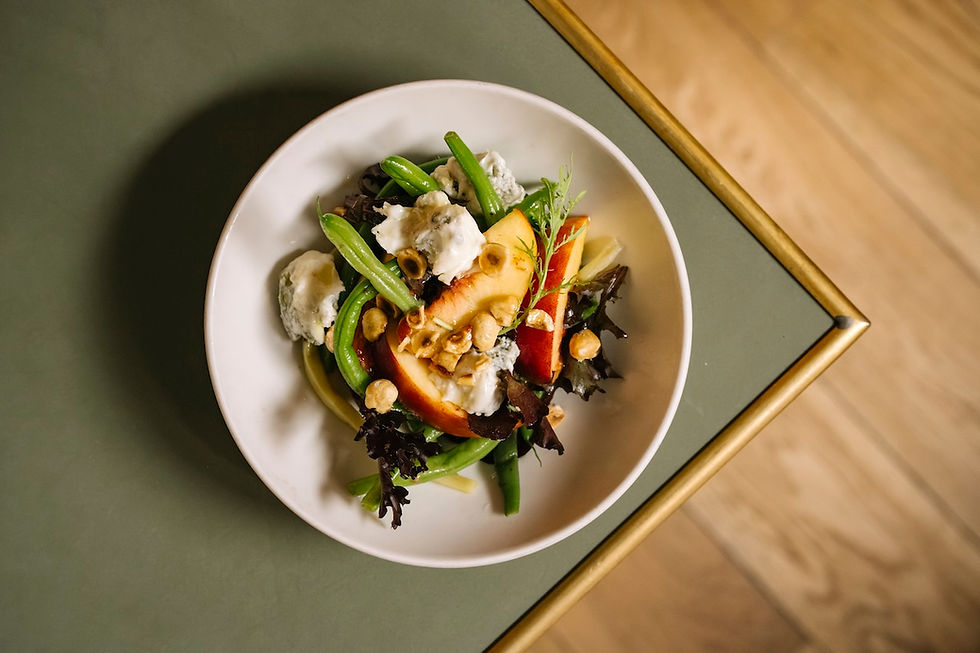
Open from breakfast through dinner, seven days a week, the restaurant has been conceived as a relaxed neighbourhood brasserie rather than somewhere demanding a special occasion. Its Mediterranean-influenced à la carte menu sits alongside lunchtime sandwiches and salads, with charcuterie and cheese joining the offering in the evening. Downstairs, meanwhile, a speakeasy-style cocktail bar gives the address another identity after dark.
That breadth matters. For this model to work, 130 Primrose needs regular customers, not charitable gestures disguised as dinner reservations. And the culinary credibility behind it has been significant.

Monica's influence
Monica Galetti initially joined 130 Primrose as Executive Chef during its development, working closely with the charity ahead of opening to shape both the menu and kitchen operations. Her role has since evolved. Galetti has stepped away from the Executive Chef position but remains involved as a mentor, with Head Chef Eric Zhang now leading the kitchen full time.
It is arguably an arrangement that gets closer to the long-term purpose of the project. Galetti's value here isn't simply having a famous name attached to the restaurant; it is the knowledge that can be transferred.
When the project launched, she described wanting to create food compelling enough to attract customers on its own merits, using seasonal British ingredients while eventually introducing elements of her Samoan heritage. Crucially, she saw those influences as another training opportunity, giving employees experience and skills capable of distinguishing them when they move elsewhere in the industry.
That is where the restaurant's two identities begin to converge. A better kitchen creates better cooks; better cooks strengthen the restaurant; a stronger restaurant creates more opportunities.
Changing the narrative
Homelessness is frequently discussed in terms of crisis: housing, emergency support and survival. 130 Primrose approaches the conversation from another angle: what happens when someone is ready for the next chapter?
A kitchen can be an unusually effective place to start. Hospitality demands teamwork, discipline, communication, resilience and responsibility. It also remains one of relatively few industries where ability can sometimes speak louder than a conventional CV. At its best, a restaurant can offer structure and community alongside employment.
130 Primrose's longer-term ambition is therefore considerably bigger than its Primrose Hill dining room. The charity wants to take the model into other UK cities and ultimately establish a recognised pipeline of skilled, diverse hospitality talent while challenging perceptions around homelessness.
There is something particularly compelling about tackling two problems simultaneously: people who struggle to access meaningful employment and an industry perpetually searching for its next generation of committed talent.

Come for dinner
Perhaps the most interesting thing about visiting 130 Primrose is that its success ultimately depends upon something wonderfully ordinary: people choosing to eat there.
Not because they feel obliged to support a charitable project. Not because they want to perform a good deed. But because they fancy breakfast in Primrose Hill, lunch on bustling Regent's Park Road, dinner with friends or a cocktail downstairs.
The restaurant's social impact happens as a consequence of those everyday decisions. There is a temptation with projects like this to make the mission the entire story. At 130 Primrose, the more compelling proposition is that the mission and the restaurant need one another. Every plate sent from the kitchen is simultaneously someone's service, someone's training and, potentially, another step towards a career.
Home Kitchen Diner proved that progression was possible. 130 Primrose now has the more difficult task of turning that proof of concept into something sustainable. For a restaurant named after new beginnings, that feels like exactly the point.