
Check In, Dine Out: Hilton London Metropole, Edgware Road


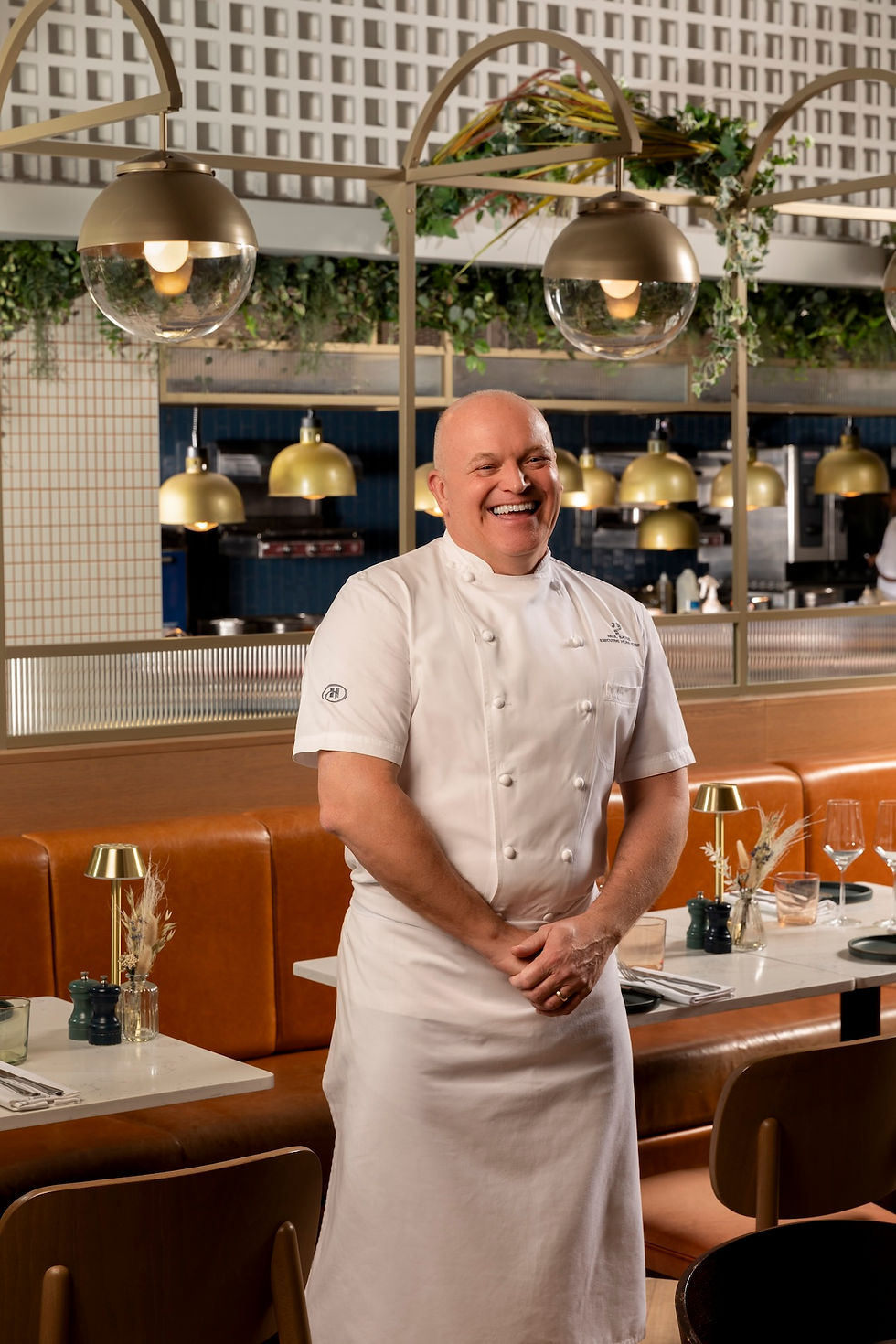
For the latest instalment of The Knife’s hotel dining series, ‘Check In, Dine Out’, we head to Hilton London Metropole, where an East London-inspired cocktail bar, locally focused restaurant and one of the capital’s largest hotel kitchen operations come together under one roof. Behind it all is Executive Chef Paul Bates, overseeing 54 chefs across five kitchens, and proving that cooking for thousands needn’t come at the expense of personality.
The Knife paid a visit and spoke to Paul about the large-scale operation.
A Big Hotel with a Big Appetite
Some hotels trade on intimacy. Hilton London Metropole trades, unapologetically, on scale. Sitting on Edgware Road, within easy reach of Paddington and Hyde Park, this is a 1,100-bedroom operation with four food and drink venues and some of London’s largest event spaces.
The numbers become even more striking once you step behind the kitchen doors. There are 54 chefs working across five kitchens, while the hotel can cater for events of up to 2,000 guests alongside its restaurants, bars, room service, private dining and conference business.
Overseeing it all is Executive Chef Paul Bates, a veteran of more than four decades in hospitality whose CV has taken him through some of London’s best-known luxury hotels, including InterContinental London Park Lane, The Beaumont, Hilton London Bankside and JW Marriott Grosvenor House.
For Paul, feeding 2,000 people begins long before anyone sits down:
"It is a huge operation, and the preparation starts long before the first guest arrives. With an event of that size, there is a lot of planning around the menu, timings, quantities, equipment, staffing and logistics. You have to know exactly what needs to happen and when, because there is very little room for error."
Then comes the moment when all that preparation suddenly needs to become dinner:
"There is a real rhythm to large events. You can be preparing thousands of individual elements and then, suddenly, everything has to come together at exactly the right moment. That is where experience and preparation really matter."
That sense of scale could easily dominate the hotel’s food identity. Instead, the more interesting story is how Hilton London Metropole attempts to make something so large still feel individual.
As Paul puts it: "Scale should never be an excuse for losing attention to detail."
East London, Via Edgware Road
The most immediately visible expression of that personality is Bow Bar. Named after its East London namesake, the hotel’s destination bar takes the character, nightlife and cultural mix of the East End and brings it west to Edgware Road. The space itself centres around a dramatic circular bar, shifting from a daytime meeting place for coffee and lighter bites into a considerably livelier proposition as evening arrives. Hilton describes it as somewhere "street attitude" meets "city refinement", which pretty neatly captures the intention.
Its latest cocktail menu pushes that East London connection further, drawing inspiration from neighbourhoods, streets and stories including Columbia Road, Brick Lane and Dalston.
Berries in Bloom takes its cue from the colours of Columbia Road Flower Market, while Brick Lane After Dark looks towards the street once the market stalls disappear and its restaurants, bars and neon signs take over. Dalston Darlin’ heads further east again, joining a list designed less as a conventional hotel cocktail menu and more as a liquid journey around a different side of London.
There is substance beyond the storytelling. Bow Bar makes its own 225 Gin, blended and bottled in London, while its food menu is built around plates designed to suit the drinking: tuna and salmon on pressed sushi rice with ginger, wasabi and soy; lemongrass and coriander tiger prawn toast; crispy chicken thigh with sweet chilli mayonnaise; spiced beef tartare tacos; and cauliflower and onion pakoras with coconut chutney.
Larger appetites are accommodated too, with everything from Yorkshire Wagyu burgers and fish and chips to ramen, steak and salads.
For a hotel bar, that breadth matters. As Paul sees it, modern guests no longer accept a restaurant or bar simply because it happens to be downstairs from their bedroom:
"There is a greater expectation that hotel dining should be an experience in its own right. People do not necessarily want to eat in a hotel restaurant simply because they are staying in the hotel. They want somewhere that has its own identity, good food and a reason to come back."
Bow Bar feels particularly conscious of that challenge. You could arrive without a room key, order a drink and never particularly feel as though you are drinking in a hotel lobby. That, increasingly, is the point.

Putting the Kitchen Centre Stage
For dinner, attention moves to Tyburn Kitchen, the hotel’s main restaurant and the clearest expression of Paul's wider food philosophy.
Its name comes from the nearby Tyburn Stone, once a historic way marker telling travellers they had arrived in London. Inside, the restaurant continues the London references through a design influenced by Covent Garden and an open, theatre-style kitchen built around its Josper charcoal grill.
The cooking is similarly straightforward in its intentions: seasonal ingredients, British produce and dishes that favour flavour over unnecessary complication.
A current menu might begin with salt-baked beetroot with goat’s curd, apple and walnuts, sesame-cured salmon with sweet pickled mooli and lobster dressing, or a crispy hash brown loaded with roasted garlic, black truffle mayonnaise and Montgomery cheddar.
Mains move between pan-seared cod with crushed baby potatoes and warm tartare sauce, aromatic lamb rump with honey-dressed carrot and coconut chutney, and a particularly comforting free-range chicken and tarragon pie. From the Josper come 28-day hung sirloin, dry-aged Lancashire rib-eye, pork tomahawk and corn-fed chicken.
It is food intended to work for an international hotel audience without becoming anonymous.
Paul knows that balance well. During a career spanning more than 40 years, he has watched hotel restaurants move from being a convenience for residents to competing directly with standalone restaurants outside their doors:
"A great hotel restaurant has to be more than just good food. It needs to understand its guests and create an experience that feels connected to the hotel, while still having its own identity."
Consistency, he adds, is crucial:
"A guest might only have one meal with you, so you have to get it right every time."
At a hotel of this size, that final sentence carries considerably more weight than it might elsewhere.

How Do You Feed 2,000 People Well?
The fascinating thing about dining at Hilton London Metropole is that the plate in front of you represents only a fraction of what the kitchen might be doing at any one moment. While dinner is being served in Tyburn Kitchen and cocktails are leaving the bar at Bow, another team could be producing a private dinner, servicing bedrooms or preparing hundreds – perhaps thousands – of covers for a conference or gala.
Each requires a different mindset. "A gala dinner might be all about precision and timing," Paul explains, "while room service requires speed and consistency, and a private dinner gives you more opportunity to focus on the detail and the individual guest."
His own role therefore becomes less about standing over every pan and more about building teams capable of operating independently:
"You cannot run an operation of this size by trying to manage every detail yourself. You need strong chefs leading each area and a team that understands what is expected of them."
It is perhaps why Paul talks as enthusiastically about people as he does ingredients. He has 54 chefs to lead, yet his philosophy is surprisingly simple: establish standards, give people responsibility and create a reason for talented chefs to remain in the business:
"I have always believed that people work harder for you when they feel that you are invested in them. We are still a kitchen and there are still pressures, but creating an environment where people can develop and see a future for themselves is important for both the individual and the operation."
When looking for the next chef to progress, technical brilliance is not necessarily the first consideration either.
"Attitude is probably the first thing I look for," he says. "You can teach someone techniques and give them experience, but you cannot teach someone to care about what they are doing in the same way."

Sustainability, Multiplied
There is another difficulty created by scale: every decision is multiplied. A little food waste in a small restaurant is one thing. Across five kitchens and potentially thousands of covers, it becomes something considerably bigger.
Hilton London Metropole says around 90% of its ingredients are sourced within 100 miles of the hotel, with Tyburn Kitchen particularly focused on seasonality and relationships with local producers.
Making that work at volume is not necessarily the easy option:
"When you are buying at the volume we do, you have to think carefully about availability, consistency, seasonality and cost. But I think it is absolutely possible to make local sourcing work at scale."
The key, he argues, is letting ingredients dictate menus rather than demanding the same produce regardless of season.
"We have built relationships with local farmers and producers, and that gives us a much better understanding of what is available and when," he tells us. "Rather than expecting every ingredient to be available all year round, we can work with what is at its best and adapt our menus accordingly."
And provenance is only one piece of it:
"For me, sustainability is also about looking at the whole operation. It is not just where an ingredient comes from. It is how much of it we use, how we manage waste and how we make sure we are getting as much value from the produce as possible."
That whole-ingredient approach can turn what might once have been discarded into stocks, sauces, garnishes or elements of another dish. "It can actually encourage chefs to be more creative," Paul explains, "because you are challenging yourself to find another use for something rather than simply throwing it away."
In an industry where sustainability claims can sometimes feel more polished than practical, there is something convincing about considering it through the unglamorous realities of purchasing, yield, waste and volume.

Four Decades, Still Learning
Paul's career began in a very different era of hospitality. "When I first started, kitchens were very different places," he remembers. "There was a much more traditional hierarchy and a very different approach to how kitchens were run and how chefs were trained."
Technology, equipment, ingredients and attitudes towards waste have all changed. Younger chefs have access to a world of restaurants, cultures and techniques through travel and social media that simply did not exist when he entered the profession.
Some things, however, remain stubbornly unchanged:
"You still need discipline, teamwork and pride in what you are putting on the plate. Technology and techniques will continue to change, but those fundamentals do not."
His longevity has recently been recognised with two significant industry accolades: Banqueting and Event Chef of the Year at the Craft Guild of Chefs Awards 2024, followed by Hotel Chef of the Year for operations above 200 covers at the Hotel Cateys 2025.
After four decades, Paul views both as collective rather than individual achievements:
"The awards are obviously a personal achievement, but I see them very much as recognition of the teams I have worked with throughout my career. Whether we are feeding a large event or delivering a meal in one of the hotel’s restaurants, there are a huge number of people behind that final plate."
And remarkably, he insists the kitchen still has the capacity to surprise him. "No two days are ever exactly the same," he says. "Even after 40 years, you can walk into a kitchen and have a completely different challenge in front of you. There is always something to learn."

Check In for London, Stay for the Food
Hilton London Metropole is a different beast from some of the smaller properties previously featured in 'Check In, Dine Out'. There are no private islands here, nor honey-coloured Cotswold villages outside the window. Instead, its appeal lies partly in what a hotel of this extraordinary scale can accomplish when food and drink are treated as more than necessary amenities.
Bow Bar gives the property a cocktail destination with an identity deliberately distinct from the traditional hotel lounge. Tyburn Kitchen turns local sourcing and the Josper grill into the foundations of an accessible restaurant proposition. Behind both sits an operation capable of switching from an individual dinner to thousands of plates without the guest necessarily seeing the machinery required to make it happen.
Perhaps that is the most impressive part. "When you get it right," Paul says of cooking at scale, "the guest does not think about the scale behind it, they just experience good food." For Hilton London Metropole, that might be the best definition of success there is.


