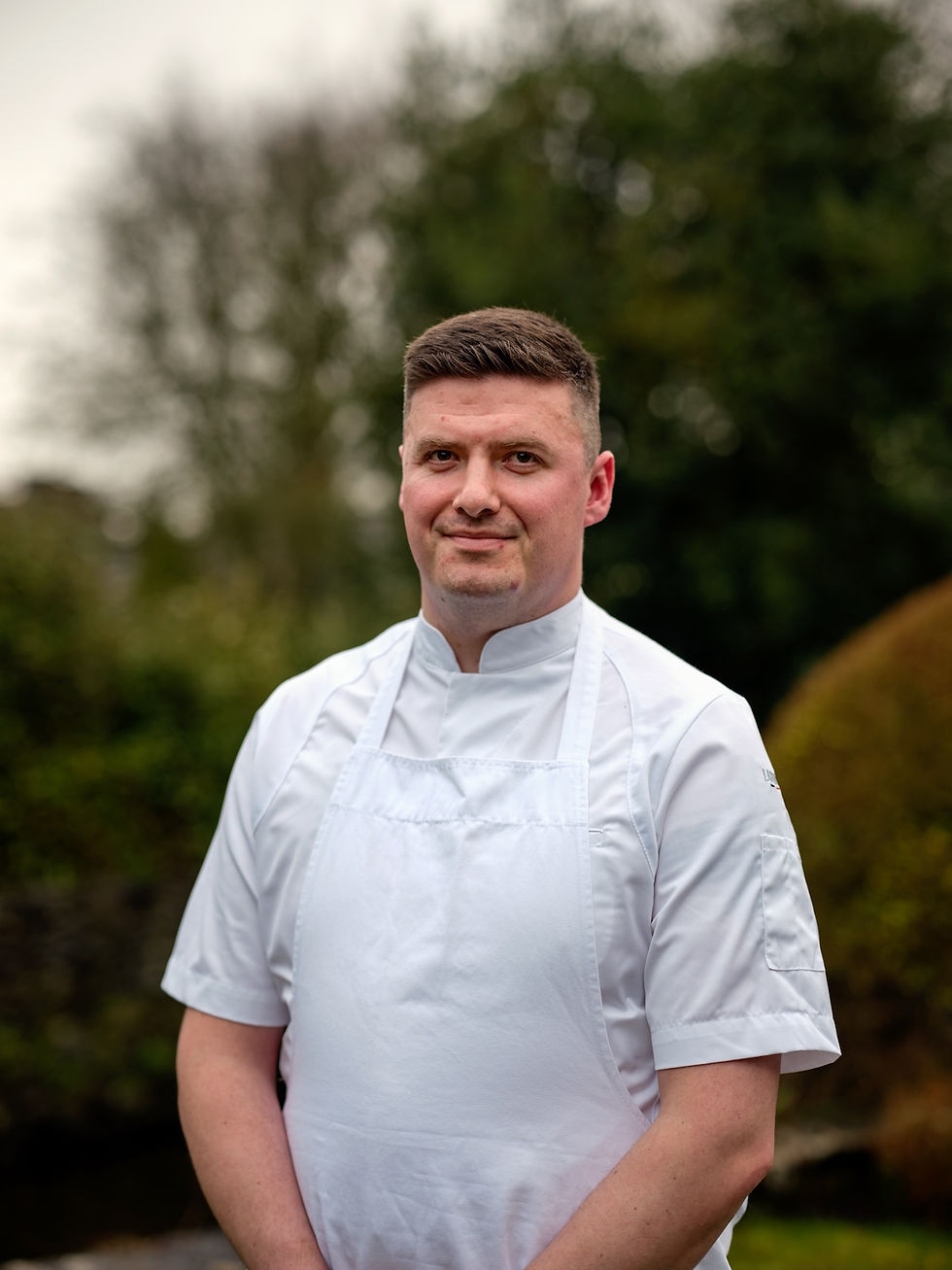
Humble Ingredients, High Standards: A conversation with Head Chef Alex Rothnie, L’Enclume

Three Michelin stars, a world-renowned culinary philosophy and an extraordinary relationship with the land. At the heart of L’Enclume in Cartmel, Cumbria, is Head Chef Alex Rothnie, who has spent much of his career working alongside Simon Rogan, helping shape one of Britain's most celebrated fine dining restaurants. From the exceptional seasonal produce grown at nearby Our Farm to a philosophy that elevates humble vegetables into culinary masterpieces, Alex's approach is rooted in creativity, curiosity and a profound respect for ingredients.
But leading a three Michelin starred kitchen involves far more than creating exceptional food. In this exclusive conversation with The Knife, Alex discusses the influence of Simon Rogan, the challenges of cooking with the seasons, maintaining L’Enclume's distinctive identity and why nurturing young talent, embracing mistakes and fostering a positive kitchen culture are just as important as perfection on the plate.

You joined L’Enclume years before becoming its Head Chef, so you’ve effectively grown up inside one of Britain’s most distinctive kitchens. Was there a point when it stopped feeling like you were learning someone else’s philosophy and instead helping to shape it?
I think it happened quite naturally and probably earlier than I realised. Simon and I seem to look at ingredients in a very similar way, so I never felt like I had to force myself to understand his philosophy.
Working together throughout the pandemic was a significant point for me. It was an incredibly difficult time for the restaurant and the industry, but working side-by-side with Simon every day really accelerated things. It gave me a much deeper understanding of what he wanted to cook and why he made certain decisions. Over time, it just became easy to contribute to his philosophy rather than simply trying to understand it.
How do you put your own fingerprints on a restaurant with such a strong identity without changing the things that made it extraordinary in the first place?
I don’t really think about it in terms of putting my own fingerprint on the restaurant. That said, it’s important that things keep evolving, as they have for the last 24 years.
When somebody sits down in the dining room, it should feel unmistakably like they are at L’Enclume and eating Simon’s food. My personality probably comes through more subtly; in the ingredients I get excited about or the techniques I find interesting.
We quite often look back at dishes or combinations of ingredients Simon has used in the past and ask what we could do with them now. I really enjoy that process: respecting where the restaurant has come from while finding ways to refine those ideas and move them forward.
Is there anything distinctly Scottish in the way you cook or think about ingredients that still follows you into the kitchen today?
I’m not sure there’s anything distinctly Scottish about the way I cook if I’m honest. Most of my career has been spent in Cartmel, so the way I think about food has naturally been shaped by the restaurant and the landscape around us.
But I’m still very proud of the larder Scotland has to offer. Whenever possible, I’ll use some of the incredible Scottish shellfish we have access to, or speak to our forager in Scotland about wild ingredients we can bring onto the menu. I think that connection probably comes through more in the ingredients I like than in a particularly Scottish style of cooking.

What’s it like working so closely with produce grown especially for the restaurant at Our Farm?
We’re incredibly lucky, and I think that isn’t always fully apparent to some of the younger chefs, because it’s all they’ve ever known. The quality and variety of produce we have just five minutes from the restaurant is amazing.
It also gives us a level of control that most kitchens could never have. We can talk about which varieties we want to grow, how much we need, what size we want something to be when it’s harvested and exactly when we want it picked. You begin to look at an ingredient differently when you’re involved in that whole process rather than simply ordering it from a supplier. It creates a really close relationship between Our Farm and the food we put on the plate.
When you’re developing a dish, what makes a vegetable interesting enough to become the starting point rather than the accompaniment?
In my opinion, a vegetable is always interesting enough to become the starting point of a dish. Some of my favourite dishes we’ve served have revolved around vegetables that most people would only consider worthy of being a garnish.
It just requires a shift in the way you approach creating a dish. In some ways, it can take more thought and effort to make a vegetable feel worthy of centre stage than it does to cook a beautiful piece of meat or seafood. But with the right care, attention and technique, I genuinely don’t think there are many vegetables that aren’t interesting enough to build a dish around.
Has being relatively young influenced the kind of kitchen you want to lead at all?
I think it probably has. I came into the industry at a time when kitchen culture was starting to shift, and I’ve been fortunate never to have worked in some of the environments you hear about.
I’m also still relatively close in age to a lot of the younger chefs who are beginning their careers. I can remember very clearly what it felt like to be in their shoes and what motivated or inspired me at that age.
The standards we expect here are extremely high, and that isn’t something I ever want to compromise on, but I don’t think high standards and a positive working environment have to be at odds with one another. I want our team to feel challenged and motivated to keep improving, while understanding the purpose behind the challenge and feeling excited about their development.

When you leave your own kitchen to cook in environments such as the Bocuse d’Or Gala, what do you discover about yourself that you perhaps can’t learn during a regular service in Cartmel?
Service at L’Enclume is unique. I haven’t worked in another kitchen where service feels anything like it. It’s a way of working that has been developed and refined over decades, and because it’s what I see every day, it can be easy to think of it as the natural way a kitchen operates.
That’s why I really enjoy cooking in completely different environments. Suddenly the systems and familiarity you rely on aren’t there, and you have to adapt very quickly. You work with different chefs, different equipment and different ways of communicating.
I think those experiences teach you which parts of the way you work are genuinely your own and which are a product of the environment you’re used to. You nearly always come back having learnt something that makes you look at your own kitchen slightly differently.
Has there ever been an ingredient or harvest that’s forced you to completely rethink a dish?
All the time. The weather in the north of England can make life very difficult for our growers. A few weeks of unusually hot and dry weather, or cold and wet weather, can completely change the succession of our crops.
We might develop a dish expecting an ingredient to be at its best for a certain period, then find that it has arrived weeks early, disappeared sooner than expected or simply isn’t going to be available in the quantity we need. Quite often this has a knock-on effect on the whole menu.
It keeps things interesting because you can’t become too attached to an idea. The ingredient ultimately dictates what we can do, rather than us forcing it to fit the dish. Sometimes having to rethink something quickly actually leads you somewhere more interesting than the original idea.
When a chef operating at your level goes out to eat, what genuinely excites you now?
What excites me most is eating something and having absolutely no idea how that particular mouthful has been created. When you spend every day cooking and thinking about food, you naturally start trying to work out how things have been made, so I love it when a dish completely catches me off guard and leaves me wondering how they’ve done it. That feeling of being genuinely surprised by food is quite rare, which is what makes it so exciting when it happens.

Do you think there’s a creative side of you that cooking satisfies beyond simply wanting to make delicious food?
It always has to start with flavour. Whatever else we’re trying to achieve, the food has to be delicious first and foremost.
But there is definitely something beyond that which I find incredibly satisfying, particularly here, where our creativity exists within quite clear boundaries. We work with the seasons, the ingredients available to us, Our Farm and the identity of the restaurant. You can’t simply do whatever you want.
I actually think those boundaries make the creative process more interesting. You’re constantly trying to find something new within them, whether that’s a different way of looking at an ingredient or a combination we haven’t explored before. It can be frustrating when something doesn’t work, but that makes it all the more satisfying when you eventually arrive at something that feels genuinely new and exciting.
How do you protect the freedom to get things wrong in a kitchen where the finished experience is expected to be virtually flawless every night?
Mistakes are inevitable, and I think it’s important that people feel they can make them. That’s obviously true during the creative process, when we’re developing dishes and trying new techniques, but it’s just as true during the normal working day. When you have a large team prepping and serving food at that level every day, things are going to go wrong occasionally.
What matters is how we respond. We want people to feel comfortable putting their hand up straight away and saying something has gone wrong, rather than worrying about the reaction or trying to hide it. Mistakes can be fixed if we know about them, and it’s much more important that we deal with the problem together and learn from it.
A big part of what makes the restaurant run so well is the systems and checks that have been built up over the years. They exist because mistakes can happen in development, in prep and during service, and they allow us to catch and correct them before they ever reach the table.
Imagine we removed the Michelin stars, the awards and even the L’Enclume name from above the door tomorrow. If somebody ate your food knowing absolutely nothing about the restaurant or the chef behind it, what would you hope they could understand about Alex Rothnie from the meal alone?
I think that’s quite a difficult thing to separate. So much of what I value in food has developed here, working alongside Simon and the rest of the team. I’m incredibly grateful to be a part of it, but I don’t think I’d ever want someone to sit down in the dining room and feel like they were eating "Alex Rothnie’s food." It should always feel like L’Enclume.
Within that, I’d hope some of the things that are important to me come through: a real care for ingredients, curiosity about what we can do with them, and an interest in taking something that can seem quite simple or humble and giving it the same attention as something much more traditionally luxurious.
I’d hope the food felt considered without feeling complicated. There can be an enormous amount of work behind a dish, but when somebody actually eats it, I think it should feel natural, accessible and, most of all, delicious.