
Cooking Northumberland from the Ground Up: A conversation with Chef / Owner Cal Byerley, Pine

At Pine, a sense of place is not a carefully constructed concept. For chef and co-founder Cal Byerley, it begins with the Northumberland farmland his family has worked for more than two centuries and extends through every element of the restaurant: native black bees, heritage grains, wild herbs, locally grown mushrooms and close relationships with the region’s farmers, foragers and producers.
In this interview with The Knife, Cal explains why returning home helped him rediscover his love of cooking, how whole-animal butchery and preservation have become Pine’s creative engine, and why the rural restaurant’s remarkable rise has only strengthened his determination to protect its original identity. He also discusses the instinctive architecture of a tasting menu, the importance of a rested and genuinely welcoming team, and his ambition to leave diners thinking differently about the land and communities behind their food.

Pine feels deeply connected to the Northumberland landscape without ever tipping into cliché. How do you translate a sense of place onto the plate in a way that still feels surprising to guests?
The honest answer is that it never feels like a translation to me because I've never needed to interpret this place from the outside. My family have farmed this land for over 200 years. I grew up here. I know which fields flood in winter, which hedgerows carry the best elderflower, and which woodlands the foragers know to head to first. So, when people talk about a sense of place, I'm not reaching for a concept; I'm just cooking with the things that are literally around me, that I've known my whole life.
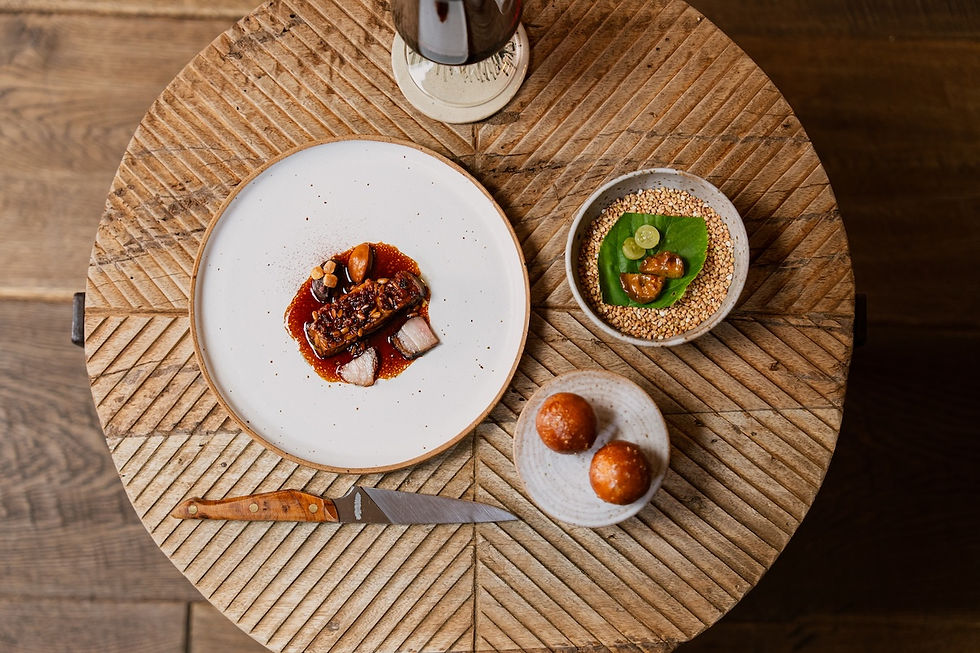
What keeps it from tipping into cliché, I think, is that we're not trying to tell people a story about Northumberland in an obvious way. We're not putting a picture of Hadrian's Wall on the menu or naming dishes after landmarks. The connection is in the ingredients themselves, the native black bees we keep on site, the mushrooms we're growing in collaboration with local mycologists, the flour from Gilchester Organics, the venison from gamekeepers we know personally. Those things already carry the place in them. Our job is just to not get in the way of that.
The surprise comes from the fact that so much of what we use is genuinely unfamiliar in a fine dining context. People don't expect to encounter pine pollen or foraged coastal herbs, or a particular variety of heritage grain grown a few miles up the road. That novelty isn't manufactured; it's just what this landscape produces if you pay proper attention to it.
Before Pine, you've spoken about falling slightly out of love with cooking. What was it about this project and this environment that reignited that obsession?
I think what happens to a lot of chefs, and it certainly happened to me, is that you spend years executing someone else's vision at a very high level, and somewhere along the way, the thing that made you fall in love with cooking in the first place gets buried under the pressure and the repetition. I learned an enormous amount at Forest Side and Rogan & Co, genuinely formative years, but there comes a point where you realise you've stopped asking your own questions.
Coming back to Northumberland changed everything. Not just because it was home, though that mattered more than I expected, but because suddenly every creative decision was mine. The sourcing relationships, the preservation methods, the shape of the menu, the things we choose to grow, all of it. And crucially, the raw material I was working with was the landscape I'd grown up in. There's something that happens when you're cooking with ingredients you have a lifelong relationship with ingredients you've watched grow, that you've helped tend, that come from farmers you've known for years. It stops being an intellectual exercise and becomes something much more instinctive.
I also think the farming heritage played a bigger role than I'd consciously acknowledged. Growing up around the land, understanding seasons not as a culinary concept but as something that dictates the rhythm of an entire year – that knowledge was always in me, but Pine gave me a context where it was actually useful, where it was the whole point. That reconnection with where I come from is genuinely what got me excited about cooking again.
A lot of restaurants talk about sustainability as a philosophy, but at Pine, it feels embedded into the actual creative process. Has working within those limits made you a more inventive chef?
Without question, and I'd go further than that, I'd say the constraints are actually where most of the interesting creative work happens. When you commit properly to using whole animals, you can't just take the prime cuts and quietly forget about the rest. You have to think seriously about every part. We ferment, smoke and dry the more sinuous parts into something similar to katsuobushi, using them as a seasoning element that adds extraordinary depth to dishes. The trim goes into charcuterie, sausage making, and garum. The bones get roasted and become the foundation of our sauces. None of that is a compromise; the flavour you get from working that way is genuinely more complex and more interesting than if you'd just used the fillet and moved on.
The same is true of preservation more broadly. Fermentation, curing, our Koji-based system – these aren't bolt-ons to manage waste; they're central to how we think about flavour. Some of the most intense and surprising things on our menu come from ingredients that have been transformed through time and process. A vegetable that's been through a careful fermentation has a completely different character from the same vegetable raw or simply cooked. Working within the principle of using everything and wasting nothing forces you to explore those transformations in ways you simply wouldn't if you had the option of just ordering in what you needed.
I genuinely think if you removed those constraints from Pine, the cooking would be less interesting, not more. The limits are the creative engine.

Pine has become a genuine destination restaurant in one of the UK's most rural settings. Do you think diners are now actively craving that sense of pilgrimage and escapism alongside the food itself?
I do, and I think what's changed is that the journey has become part of the meaning for a lot of people. You don't end up in East Wallhouses by accident. You've made a deliberate decision to come here, you've probably driven through some extraordinary countryside to get here, and by the time you arrive, there's already a sense that something intentional is happening. That context shapes how people receive everything that follows.
But I think there's something deeper going on, too, which is that people are genuinely more curious about where their food comes from than they were even five years ago. When someone sits down at Pine, and we can tell them that the flour in their bread came from a mill a few miles away, that the honey was produced by our own bees on site, that the mushrooms were grown in collaboration with local growers we work with directly, that specificity means something to people now in a way it perhaps didn't before. They want to feel a real connection to the food and to the land it came from. A restaurant embedded in actual farmland, surrounded by the landscape it draws on, offers something very hard to replicate in a city.
The remoteness isn't a disadvantage. I think for many of our guests it's become one of the most important parts of the experience.
Your menus constantly move between delicacy and boldness. How consciously do you think about rhythm and emotional pacing across a menu?
It's a bit of both; there's conscious thought behind the architecture of a menu, but a lot of the rhythm comes from instinct developed over years of cooking and eating. You learn to feel when a sequence of dishes is building properly and when it's losing the thread.
What I'm always thinking about is giving people enough contrast to stay genuinely engaged across the whole meal. If everything is subtle and delicate, however beautiful the individual dishes are, guests start to drift. And if everything is big, intense, and smoky, the impact of any single dish diminishes. The movement between registers – something almost ethereal early on, then something with real smoke and savoury depth, then perhaps something that surprises through acidity or brightness – this is what keeps a meal feeling alive rather than like a sustained single note.
The seasonal nature of what we do shapes that pacing, too, in ways that are sometimes unpredictable. The kitchen garden and the landscape around us dictate a lot of what's available, and those ingredients bring their own character. Early spring produce tends towards freshness and restraint. Deep winter ingredients often carry more weight and intensity. Following those natural cues means the rhythm of the menu shifts through the year in a way that feels organic rather than imposed.
The relationship between sweet and savoury at Pine feels unusually fluid. Do you deliberately blur those traditional boundaries when developing dishes?
Deliberately, yes, but it also comes very naturally when you're working closely with the landscape here. So many of the ingredients we forage and grow sit right on that boundary: sea buckthorn, berries, rhubarb, certain flowers and pollens. They carry acidity, brightness, a kind of sharpness that makes them as useful in a savoury context as they are in something more obviously sweet. When you're working with those ingredients every day, the conventional division between sweet and savoury starts to feel quite arbitrary.
I also think my background in pastry plays a big part in this. Working as a head pastry chef, you develop a very particular sensitivity to sugar, acidity and texture, and how small adjustments shift the character of a dish entirely. That thinking doesn't stay in the pastry section when you move into broader menu development. It bleeds into everything, so you find yourself reaching for a fermented berry or a preserved fruit element in a meat course, not because you're trying to be unusual, but because you know it will create the balance the dish needs. Ian and I share that instinct, and I think it's one of the things that gives the menu its particular character.
Pine has earned major recognition very quickly. Has success changed the way you cook, or has it made protecting the original identity even more important?
Protecting the original identity, absolutely. And if anything, the recognition has made that feel more urgent rather than less. When we opened, we had a very clear sense of what Pine was and what it was for: the local sourcing, the relationships with specific farmers and producers, the whole animal approach, the commitment to our own growing operation. Those things weren't a pitch or a positioning statement; they were just how we believed a restaurant should operate. The risk when recognition comes quickly is that the success becomes the reference point, and you start making decisions based on maintaining that rather than on the original instinct.
We've been very deliberate about not letting that happen. The network of producers we work with, within a 20- to 30-mile radius of the restaurant, those relationships are the foundation. Gilchesters for our flour, Wilde Farm for meat and poultry, Doddington Dairy for cheese, our local gamekeepers, foragers, the beekeeping society, and local mycologists we're growing mushrooms with. These aren't convenient suppliers; they're genuine partnerships built over time, and they're what make Pine what it is. The moment we started compromising those for the sake of convenience or scale, we'd be making something different. And whatever that was, it wouldn't deserve the recognition we've been fortunate to receive.
There's a warmth and looseness to Pine that feels quite different from the formality traditionally associated with high-end tasting menus. Was creating that atmosphere just as important to you as the food itself?
Completely, and I'd say it was non-negotiable from the start. Sian [Byerley, Cal's wife] deserves enormous credit for this; the warmth people feel when they walk into Pine is something she's shaped and sustained, and it comes from a genuine belief that guests should feel genuinely welcome rather than assessed. That's a harder thing to achieve than it sounds, especially as the food becomes more complex and the recognition grows, and there's a natural gravitational pull towards a certain kind of formality.
We made a conscious decision early on to work a four-day week, and that choice has had a real effect on the atmosphere in the restaurant. A team that has proper rest, proper balance, which isn't ground down by relentless hours, those people engage with guests differently. There's a generosity in the service that's hard to manufacture but very easy to feel, and I think it comes directly from the fact that our team genuinely enjoy being here.
The building itself is part of it, too. This was a cattle byre. It's a beautiful space, but it has an earthiness to it, a connection to its agricultural past, which resists the kind of hushed reverence that some fine dining environments cultivate. We lean into that rather than trying to smooth it away. I want people to feel like they can relax and actually be present for the meal, not perform their appreciation of it.
You grew up around farming and produce before becoming a chef. Are there ingredients or flavours from childhood that still subconsciously shape the way you cook today?
I'm certain of it, even when it's hard to trace the exact connection. Growing up on and around a farm means your earliest relationship with food is completely different from most people's. Seasons weren't a culinary concept; they were a physical reality that dictated everything. You knew when things were ready because you could see them, smell them, because the whole rhythm of life around you changed. That wires you differently as a cook. Ingredients aren't abstract to me. They have a context, a growing cycle, a relationship to the soil, the weather, and the people who tended them.
I think that's why the bees matter so much to me personally. Native black bees were part of the landscape I grew up in; their presence or absence tells you something real about the health of the environment. Having our own colony on site and working with the Northumberland Beekeeping Society isn't just a sustainability decision; it's something that connects directly to a much older understanding of how a farm and a landscape should function. There are flavours, certain wild herbs, particular varieties of root vegetables, the kind of earthiness you get from really good soil, which feel almost like a memory when I work with them. I couldn't always tell you why they feel right, but I trust that instinct because I know where it comes from.

What excites you more creatively: a luxury ingredient or something humble and hyper-local?
The humble and hyper-local, every time, and I don't think it's even close. The luxury ingredient arrives with its own expectations already attached; you know what it's supposed to taste like, you know what it's supposed to do in a dish, and you know how guests are going to respond to it. There's very little discovery in that. The interesting work is already done for you.
What genuinely excites me is finding something that most chefs would walk straight past and working out what it can actually do. The mycologists we're collaborating with to grow specialist mushrooms, some of those varieties are extraordinary in ways that have nothing to do with prestige or price. The foraged ingredients that come from the fields and woodlands right around the restaurant – pollens, roots, particular leaves that only appear for a few weeks of the year – those carry flavours and textures that you simply cannot buy in from anywhere. They exist in this place, at this moment in the season, and the challenge of finding the best possible context for them in a dish is the most creatively alive I feel as a cook.
Honestly, the most technically challenging and creatively rewarding work we do at Pine often involves ingredients that would be almost invisible on a menu if you listed them without context. That gap between their apparent simplicity and what they can actually deliver when you understand them properly, that's where the real cooking happens.
The North East is having a real culinary moment. Do you feel a responsibility for Pine to help reshape perceptions of the region? And when diners leave, what do you hope lingers with them most?
I feel it, though I'm cautious about how I frame it. Sian and I came back here because we love this place, because Northumberland is genuinely extraordinary, and we wanted to build something here that reflected that. If Pine plays a part in reshaping how people think about the North East as a food destination, that's something I'm proud of, but it was never the primary motivation. The motivation was always to make something honest and rooted and genuinely good, in a place we care about deeply.
That said, I do think there's something important happening here and in the wider region right now, and I think it matters that the restaurants driving it are places with real roots in their communities, places that are working with local farmers and producers, which are genuinely connected to the landscape they operate in, rather than simply transplanting a London template to a cheaper postcode. Pine can be part of demonstrating that serious, ambitious, creative cooking can thrive in a rural setting, that the North East has a larder and a food culture that deserves to be taken seriously on the world stage. Given where we've been placed in national and international lists, I think that message is getting through.
As for what I hope lingers, it's not a specific dish. I hope people leave with a slightly different relationship to where their food comes from. I hope they've felt the landscape in the meal, that they go home curious about the farmers, foragers, and producers we work with, and that some of that curiosity changes the choices they make about what they buy and eat. A meal at Pine should feel like more than a great night out. It should feel like the beginning of a different way of thinking about food, and the land and communities that produce it. If that's what stays with people when they leave, then we've done something that matters.


