
Why Robin Read Finally Opened His Own Restaurant: A conversation with Chef-Owner Robin Read, The Counter

For most chefs, opening their own restaurant is the dream. For Robin Read, it took more than three decades in professional kitchens, six hotel openings, Michelin starred training and 16 years as Executive Chef of the Firmdale Hotel Group before that dream became reality.
Today, Robin and his wife Greta run The Counter in Tunbridge Wells, one of Kent's most exciting dining destinations. In this conversation with The Knife, Robin reflects on stepping away from corporate hospitality, finding creative freedom, building a restaurant around personal connections with producers, and why he wishes he'd taken the leap sooner.

After overseeing hundreds of chefs for 16 years, what did opening your own restaurant allow you to do again?
It wasn't really about what I didn't want to do anymore, it was about getting back to what I loved doing in the first place.
The hotels were incredible. I got to open properties, build bakeries, training academies and work with brilliant teams. But over time I found myself getting further and further away from the kitchen. I still wore a chef's jacket, but I was standing at the pass more than I was actually cooking.
At some point I realised I wanted to get back to doing what brought me into the industry in the first place. I wanted to cook again.
The other thing is that when you work for someone else, even with supportive bosses, you still have to justify every decision. Now, if we think something will improve the guest experience, we can make it happen. That creative freedom is hugely rewarding.
Was there a moment when you realised you were building other people's visions rather than your own?
I think every chef dreams about having their own place. When I was Head Chef for Marco Pierre White, I was cooking his food and working under his name. Moving into hotels gave me more ownership creatively, but it was probably around then that I started thinking seriously about building something of my own.
The Counter wasn't necessarily the original plan. It really evolved after lockdown when Greta and I started cooking tasting menus in people's homes. We quickly went from doing one a month to one or two a week.
I loved that style of cooking. There's a lovely pace to a tasting menu. You can spend more time on the details, on the presentation, on the whole experience. It allows you to create something much more complete. That's really where The Counter came from.
Your family history includes both a butcher and a greengrocer. Do you see their influence in what you do today?
Absolutely. One thing that has always appealed to me is going directly to the source. Being back in Kent means I can visit farms and producers much more easily than I could when I was in London. I can ring them and ask if I can pick something up the next day. It's a much more personal relationship.
When I talk to my mum about her dad's butcher shop, or think about my great-grandfather's greengrocer business, there are similarities. They cared about personal service. They cared about presentation. Their displays were famous locally. We do the same thing now, except our display happens to be on a plate.
What finally convinced you that the risk of opening your own restaurant was worth taking?
Probably my age. I'm 52 now and I got to the point where I thought, "If I don't do it now, when am I going to do it?"
Covid was a big catalyst. Like a lot of people, it made me stop and think about what I really wanted from life. We'd already been looking for sites for years, but I don't think I was fully committed during those early years. I always found reasons why something wouldn't work. Coming out of Covid, I became much more determined. We had some savings, we had a vision, and I thought we should stop making excuses and just go for it.
It's been hard. Opening a restaurant is never easy. But I wouldn't change it for the world.
You trained under legendary figures including Nico Ladenis and Marco Pierre White. What lessons have stayed with you?
The biggest thing is respecting the craft. There are no shortcuts. I didn't become a Head Chef until I was 30 and for me that was the right thing. I felt ready.
Today, we still use recipes and techniques I learned 30 years ago. We've got a Swiss meringue on the menu at the moment and the fundamentals haven't changed. Technology changes. Trends change. But a solid foundation in the basics never goes out of fashion.
The other lesson is that your team matters more than anything. I've worked in some intense kitchens and some challenging environments over the years, but I've always believed that if you look after your team, everything else becomes easier.
What do guests learn from sitting at the counter that they wouldn't experience elsewhere?
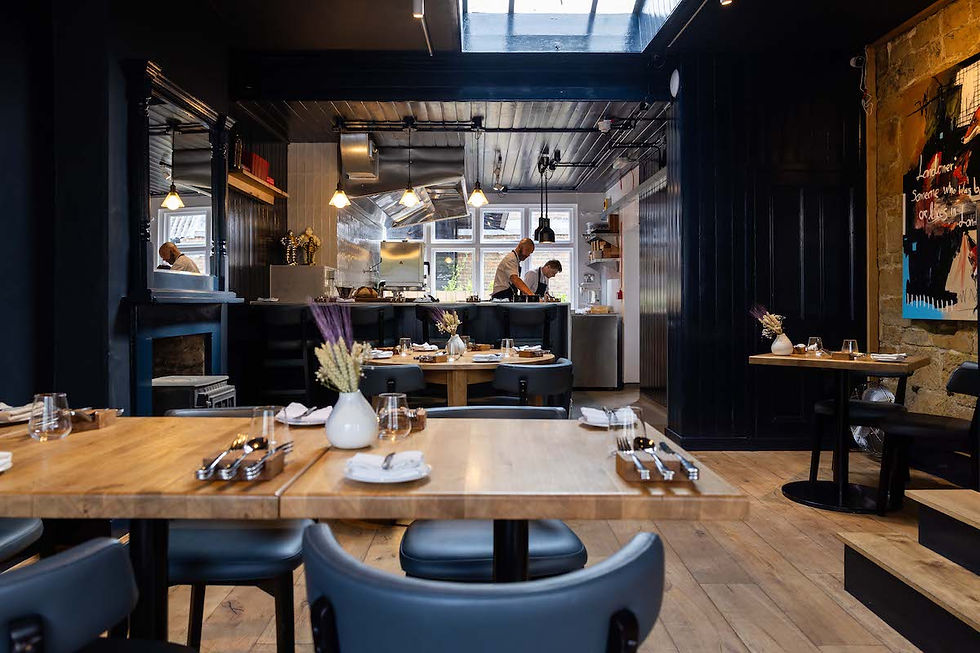
I think they see how much work actually goes into every plate. They can see everything. Every dish being cooked, every plate being finished. What often surprises people is how calm the kitchen is. There are no raised voices, no shouting, none of the old stereotypes. People tell us all the time they expected something much more chaotic.
But for me, cooking requires concentration. I'd rather focus on what I'm doing and then spend time talking to guests when the moment is right. By the end of the meal there's usually plenty of conversation, but during service the focus is on giving them the best experience possible.

Has a producer ever completely changed how you think about an ingredient?
ChalkStream trout immediately comes to mind. Years ago they turned up at the hotel with a couple of trout fillets and asked if we'd like to try them. At first I wasn't expecting much. But the quality was exceptional.
What impressed me even more was seeing the journey they've been on since then. We still use their trout today and now you'll find it on menus all over the country. Working closely with producers like that makes you appreciate how much care and expertise exists long before an ingredient reaches the kitchen.
Did you ever question whether opening a restaurant was the right move given the challenges facing hospitality?
Not really. Before opening The Counter, we ran a pop-up for almost a year in the village where we live. Originally it was meant to last 11 weeks. It ended up running for 11 months. It sold out consistently. That gave us confidence that there was an appetite for what we wanted to do. The pop-up became a testing ground. We refined the concept, refined the menus and built relationships with guests. By the time we found the site for The Counter, we already knew there was demand.
How do you balance luxury hospitality standards with a relaxed atmosphere?
Simplicity. We try to remove unnecessary formality wherever we can. The service style is natural rather than scripted. We want conversations to feel genuine. The team understands the dishes and wines, but we encourage them to explain things in their own way.
The goal is to make people comfortable from the moment they walk through the door. If guests feel relaxed, they'll enjoy themselves more. That's ultimately what hospitality should be about.

Tunbridge Wells isn't the first place most people think of when discussing destination dining. What did you see in the town that others perhaps overlooked?
I'm probably biased because I grew up here, but I think it's a fantastic town. It's got room for more independent restaurants, more coffee shops and more interesting businesses.
For a long time there were a lot of chains, but that's changing now. Since we've opened, more independents have appeared and that's great to see. I think Tunbridge Wells deserves to have a stronger food identity than people perhaps give it credit for.
You run The Counter alongside your wife, Greta, who curates the wine programme. How do you stop conversations at home becoming restaurant meetings?
We're still working on that! Recently we've brought in a restaurant manager, which has changed things considerably.
Greta isn't in the building every day anymore, which gives both of us a little more breathing room.
It's actually helped the business, too. When you're immersed in something constantly, you can lose perspective. Greta can now look at things with fresher eyes and often spots things the rest of us have missed.
Finally, if you could give your younger self one piece of advice, what would it be?
Open your restaurant earlier. That's probably the honest answer. I don't regret my training or the path I've taken, but I do wish I'd trusted myself sooner.
Opening a business is scary, it always will be. But I think sometimes you have to trust your instincts and take the leap. I'd still tell younger chefs to learn their craft properly. Build your foundations. Keep improving. But once you're ready, back yourself.
And above all else, find something that makes you smile. If you enjoy what you do, it never really feels like work.


